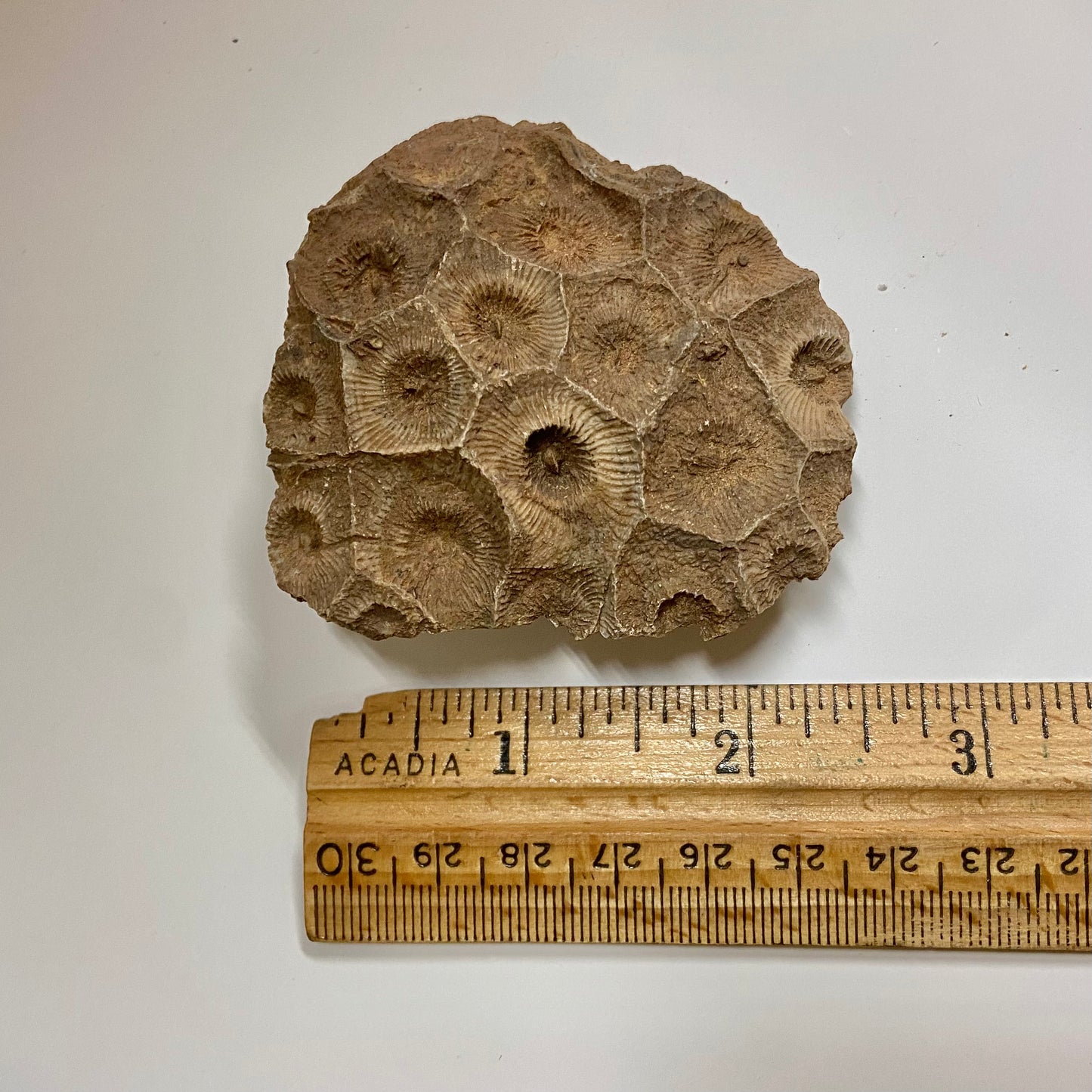
Rugose corals are an extinct group of coral that lived on the ocean floor or within reefs, feeding off of tiny microplankton.
Rugose corals can form solitarily or as a colonial mass.
The skeletal wall of the coral is made of calcite and called the theca, which can be covered by the outermost skeletal sheath, the epitheca. Growth lines along the epitheca can appear wrinkly, hence they are called Rugose Corals -- "ruga" being Latin for "wrinkled."
The circular, bike-spoke parts are septa, and the lines radiating out from the center of the septa (columella) are costa. Costa are not always visible in specimens due to preservation quality.
The most well-known rugose coral is the Michigan Petoskey Stone (part of the Hexagonaria genus) which were rounded and tumbled by glaciers.
Fun fact: Corals grow a little bit every day and produce growth rings. Scientists studied daily fossil rugose coral growth lines, finding on average 400 lines for Middle Devonian corals (meaning around 400 days in a year 380 million years ago) and less than 390 rings for Pennsylvanian corals (around 390 days in a year 300 million years ago). This discovery suggests that over time, Earth's rate of rotation continues to slowly decrease.
This particular specimen has wonderfully detailed preservation of the septa and costa. The fossil is preserved with a reddish hue.